Episode Transcript
FAWN: [00:00:00] situations and relationships, friendships, all of it. When they feel like it's unbearable, there's a lot happening sometimes things feel hopeless and you're trying to maneuver so many things and swim upstream. Like going against the current,
here are two words given to me by a beautiful coach this week voice acting coach and we wanna share them with you on this episode. There are two words, so lean in, listen, and I think this will help you a lot.
there you are. There I am. I've always been here, I suppose. Yay. Hmm.
FAWN: Hello, welcome to our Friendly World.
MATT: Hello everyone.
FAWN: We're talking today about two words. Two words. If we remember these words, they actually shift a lot. They helped me this week. I was given these two words by, a casting director, I really respect [00:01:00] and. They not only helped with my career, but really the, with communication with Matt, with the state of the world, 'cause I'm trying to make change, but I can't and I feel helpless.
So I'm like, why bother? Or like, let me do this herculean effort to try to maneuver this way. And you're exhausted and disappointed. It happens with friendships, it happens with career, it happens with dealing with your kids or dealing with neighbors or whatever the situation is. So here we go guys.
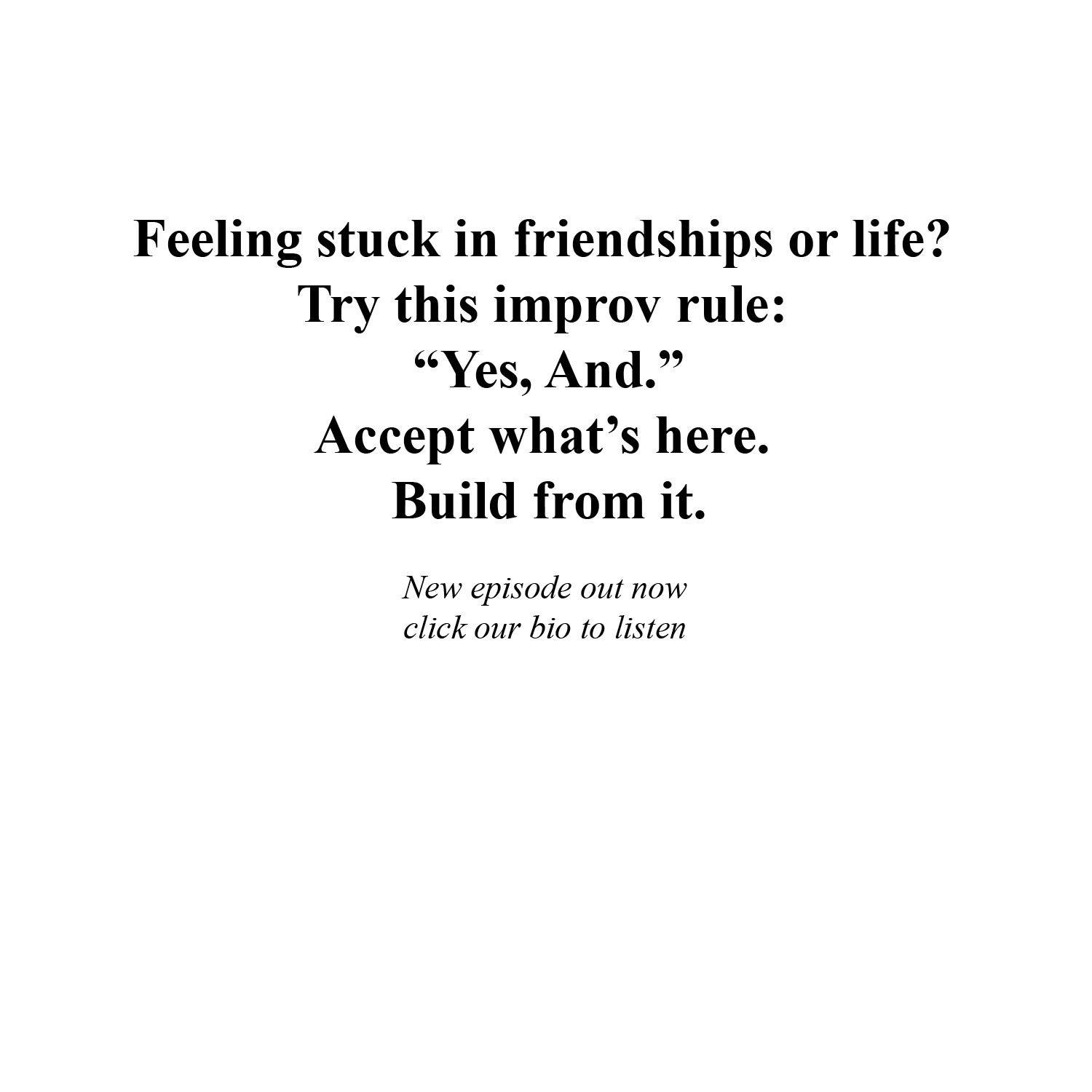
Today we're talking about improv's motto and the two words are "yes," "and." So let me explain By the way, Matt wants to say hi.
MATT: I got to say hi. I'm, I'm, I'm actually completely good right now. Thank you. Oh, you okay? Alright. Thank you for looking out for me.
FAWN: Are you being sarcastic? Yes. And alright. Was that Sarcas?
No. Okay. Love you babe. Love you too. Sorry I'm a little bit scattered in my head so I don't remember. [00:02:00] Like, I really wanted to get this point across. So I don't know, did you speak, did you say hi? I don't know. I don't remember. Alright, so here we go, dear. So the yes, and, and this is what I was told. These two words hold the secrets to create flow.
This is what they mean. I accept what's here and I'll build from it. And I think that's the, that's the main thing, Matt, is acceptance, right? Like, okay, this, this thing is really crappy. All right. That's the way it is. What can we do to build from it? Right? Right. So once again, she said my, my coach, my, the director said, I accept what's here and I'll build from it.
So that mindset transforms everything from your work, to collaborations and even confidence, self-confidence. So imagine applying it to your, career, Alright. [00:03:00] Yes. I didn't get that job and I learned what to try next.
MATT: There you go. Or. Yes, I didn't get that job and it's time to move on and I'm sure there's a wonderful other opportunity awaiting me and I have to find that. Yes, and I'm gonna study twice as hard. Yes. And they asked me that stupid question I couldn't answer. I need to come up with a good answer to that.
FAWN: Right.
MATT: You know, and on and on and on as far as like, quote unquote acceptance. So, you know, at no point are we saying I didn't get that promotion at work, so I guess I didn't deserve it. I guess it's, I guess I'm just gonna stay exactly where I am or anything else.
FAWN: And yes, that friendship didn't happen, or yes, that friendship is over, and this is what I'm going to create right now,
so that when I, you know how you end something is how you begin something. Mm-hmm. So you don't [00:04:00] repeat the same patterns or like also, yes, I'm nervous and I'll show up anyway. Yes. I'm nervous to go out and meet this person. Yes. I'm nervous to go out in the world and be with some people. I'm gonna show up anyway.
Yes. I'm nervous to state my opinion, or yes, I'm nervous to, I don't know. What do you think, Matt? Like what are we nervous about? As a collective,
MATT: right? Ah, it's, it's difficult. Everybody has their own stuff and sometimes it's even a yes, and on top of it's like, it's like, I'm gonna have ice cream.
Yes. And I'm gonna put chocolate sprinkles on top. It doesn't always have to be this kind of point counterpoint thing too. It's just,, it's question of, well. Building on whatever that it is.
FAWN: Yes, true. It doesn't always have to be something terrible, but that is usually the block. And I'm true.
I'm mainly fo [00:05:00] focusing on how we can get over the hurdles of mm-hmm. Of life. Right. I get it. The hurdles of what's going on in the country, the hurdles of all the violence we're seeing, the hurdles of the tragic events that we're seeing, okay, this has happened, or like. Like us, like we were in another dire situation the last week where we, it was 17 degrees outside.
We had no heat, no hot water, and no, no neighbor helped us out. Not even to say, can I help you? Do you need anything? Are you okay? Because when the house inside is 53 degrees. It's dangerous, right? But no, it seemed like nobody cared. So yes, this is happening. What are we gonna do from here? You know? Yes, the neighbors don't care.
What are we gonna do? How am I gonna build a life that I want? How am I going to have community that I want? What, what do I, what baby steps can I take? So yes and [00:06:00] yes. And. So, I know you're always positive, Matt, I'm, I just wanna make sure that we have tools and we really learn how to deal with the hurdles and
MATT: no argument.
I just wanted people to understand it's not always going to be on that negative side. I understand. And that's where the focus is. I mean, there's a whole kind of theory in psychology, which is the, um, uh, psychology of acceptance. Freud and this other guy much later got into it and, and you know, they noticed that, um, in saying yes
and it's not like we're discarding our, uh, emotional experience. We're actually on some level validating it because we're saying this thing happened and, and I have emotion about it, but it also in saying yes, and we're also looking at really supporting, uh, our mental well and, and emotional wellbeing.
Mm-hmm. Because what we're doing [00:07:00] is we're shifting our attention. So we're literally like kind of putting it behind us so we can go forward into something else.
FAWN: As I'm listening to you, I understood something else as you were saying this because you are also not getting into an argument.
So let's say you're faced with a friend or someone that has really challenging beliefs, there's no point in arguing about it. So to, to use that "yes, and"- it's like, okay, fine. You're saying my mom is ugly. Yes. And you know, that's how you and your friends used to play. Right? True. So there's no argument, you're not getting stuck in this battle.
You're dropping it in a very, unenergetic way. There's not a charge, so the person wants to fight. Right? Right. Because you're, in a way, you're validating their existence, their beliefs, without saying much, you know, without saying much. Right. So yes, and,
MATT: but then what we [00:08:00] would do is we would literally take their argument yes and completely, like throw it under the bus and say, well, you're right, but.
FAWN: But, but,
MATT: and unfortunately I can't really get into the things we used to like go bile back and forth about, because yeah, it was, it was rated r it was a little foul, but rated R um, yeah, we would talk about, let's, let's just say we talked about how, you know, how big somebody's arm is, you know, and being like, I'm super buff and blah, blah, blah, blah, blah.
And he'd be like, yeah, for a mouse.
FAWN: Right.
MATT: Or Okay. That,
FAWN: that's getting cruel though. That's getting into like, uh, what do you call it, junior high school, male? Like, yeah. But, uh, I don't know, what is it, what, what's the term for when young boys like locker room talk basically. Yeah. Whatever. But anyways,
MATT: but yeah, absolutely.
But to, to finish kind of my thought is, going through "yes, and" actually helps us foster that lovely [00:09:00] buzzword we've had since 2020- Resilience. It does, because again, you're focusing on where you wanna go, you know? And what we say over and over again is what you focus on grows. So focusing on forward and studies have shown that that kind of being in this head space enhances life satisfaction and increases inner peace.
FAWN: Yeah. Because you're not fighting it. It's like. Okay, this boulder just landed here. Okay. Alright. I'll call my insurance agent
MATT: and get things sorted.
FAWN: Do you have more to say about this particular one? Because here's another one. Yes. This is new and I'm capable. Mm-hmm. So, like for me, it's like, I don't know, do you feel this way?
Sometimes you, deep down, I've noticed, like subconsciously, super subconsciously, even though I want these jobs, I'm like, don't give it to me. I don't know. [00:10:00] I can't like what, if, you know what I'm saying? The pressure of like technically doing it. Right, right. Or being in front of all these huge people. Mm-hmm.
And, um, what if I screw it up? It's so much pressure, so much that I build. For myself, then I'm like, you know what, just don't give it to me. Even though I'm, I'm applying for it, even though I'm going for it. Right. Like super subconsciously. And I have to clear that because I really do, I do wanna do this project.
I am totally capable. So yes, this is new, scary. It's new and scary, and, and I'm capable. Right, right.
MATT: Uh, similar, similar thing for me, actually, two weeks ago, I was interviewing for a position that is an interesting one and would require me to stretch. So had I walked into it going, oh my goodness.
Oh my God. But I was like, I'm gonna interview for this. Yes. And I'm gonna [00:11:00] be honest, open and make sure they understand where my head is at, and multiple ands If it fits, it fits. And if not, oh well. Mm-hmm. Onto my next adventure, which is one of the things I used to love to say. And I, I don't say it enough anymore, but I do say it.
FAWN: Right. Yes. And they wouldn't have given you the job if they felt like you couldn't do it.
MATT: And there you go.
FAWN: It really helps with the kids, like when they come at you sometimes when they're in a bad mood. Yes. And you know, it, it just, you are less, once again I'm repeating myself, but you're less charged, you are less, invested in a way.
You are more about the flow. And what it is, is really, and this is what it was, shared with me is that you just need the awareness in the moment,
and that's what it does. It brings you in the moment in present tense. In [00:12:00] present moment. Yes. And
MATT: right. Right. And oftentimes. What you'll also see, though, if, which is a little weird, and it can be maybe disconcerting, but if somebody comes at you with a problem saying yes and puts the shoe on the other foot on some level because okay, you came to me with the problem.
And what exactly is it you want me to do about it or, and how do you think we can address it? And how do you think we can fix it? And so I'm already moving towards solutioning and I'm not in any way telling this person, you're wrong, you're silly, or, I'm sorry you feel that way. And all those other lovely things we love to say, which just kind of annoy people.
FAWN: Yeah. And I keep thinking about work, but mostly about friendship. Like, yes, I am in a situation where I just don't feel like going out and I respect that, and I'm going to use this time to [00:13:00] settle down and center myself, and I'll be ready to go out when I feel like it, and I know I'll make friends soon.
I know that I can change my situation, right? Yes. Things may look bad in the world and there's always hope. Yes, things look scary
and things are always in a state of flow up and down, swirly things change all the time.
MATT: Definitely true.
FAWN: Yes, this is a short episode today, and you'll have time to put it to good use, hopefully.
MATT: Sounds good.
FAWN: Have a beautiful every day.
MATT: Be well.