Episode Transcript
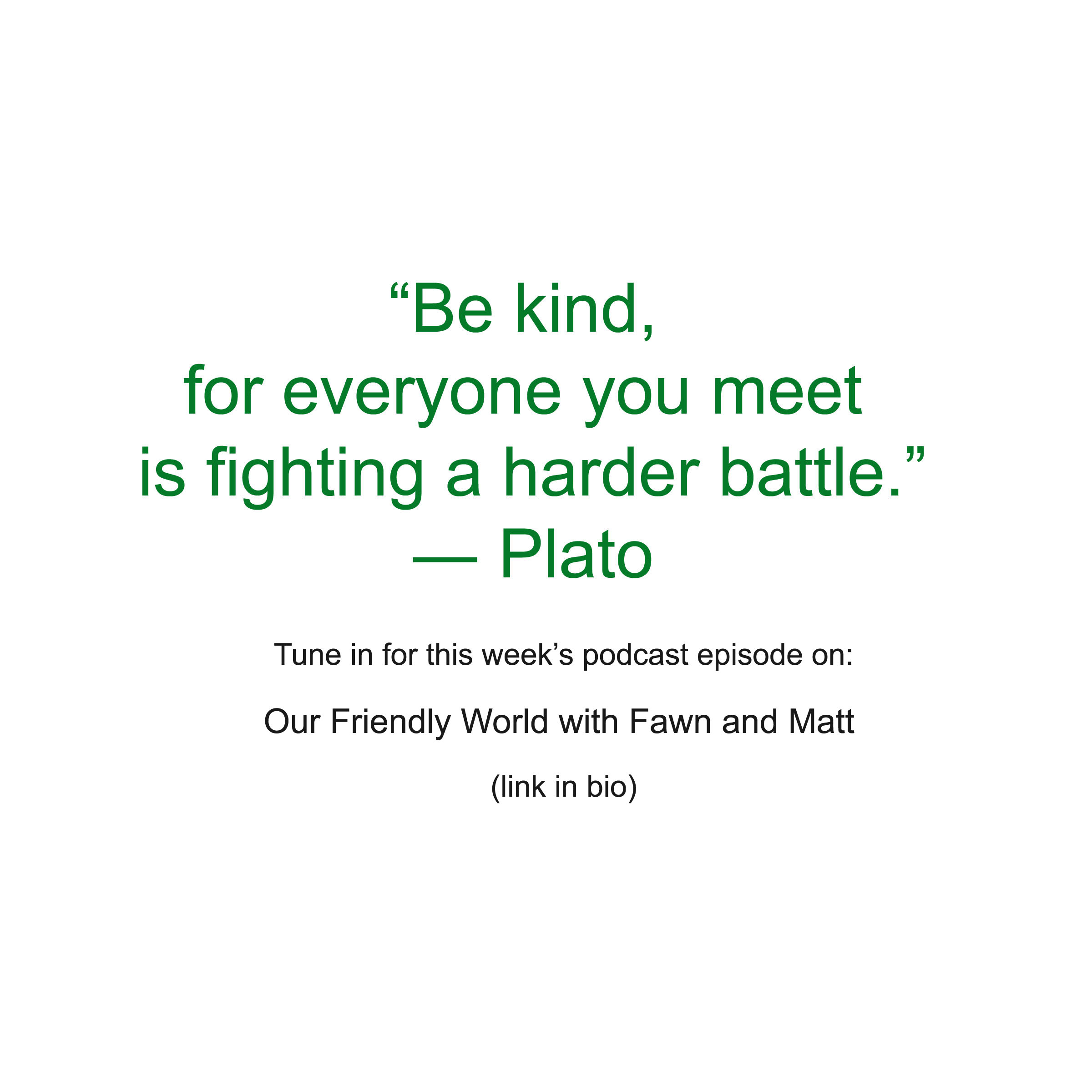
FAWN: [00:00:00] Let's take a little walk towards a friendly reminder Sometimes we cannot see the whole path. Our job is not to see further. Our job is to take the next faithful step, not the entire staircase, the next step.
This was advice given to me the past week that really helped, so I'm passing it along to you. Thank you for joining us. Here we go
Welcome back to our friendly world, everybody.
MATT: Hey. Hello.
FAWN: Hello. So
Sometimes we can't see the whole path
MATT: True
FAWN: And so maybe our job is not to see further, even though it's really good to always think of four moves ahead, what's going to happen down the line.
MATT: Right.
FAWN: But I think sometimes when there's so much anxiety and overwhelm, being tired, by thoughts especially, [00:01:00] our job is to take the next faithful step, not, again, not the entire staircase, but the next step.
MATT: Oftentimes, yes, when a, when a project is so big, it's important to just focus on the next thing that needs to happen.
FAWN: Baby steps
And I thought we could transition this since it's about walking
MATT: Oh, do you wanna talk about the Vierdaagse?
FAWN: I mean, you've only been talking about it for the past two weeks. So yeah.
MATT: And I know I just butchered that. I am sorry to all of our Dutch, uh, listeners out there.
FAWN: Wait, say it again.
MATT: No.
FAWN: Okay, never mind.
Never mind.
MATT: It literally translates, it's one word, but it literally translates into four-day evening walk. Gotta love the Dutch. I love that.
FAWN: A four-day evening walk. Yes. Why can't they just say a four evening walk?
MATT: Because
FAWN: they're- A walk for four evenings ...
MATT: because they're Dutch.
FAWN: Okay. Well, it's probably the [00:02:00] translation.
MATT: It, it, it very well could be, but it's all one word. This is a annual tradition actually across the entire country of the Netherlands, believe it or not. And it's four days. It's for kids, and it's a 5 or 10 or even in some places 15K walk that you undertake every day for four days. Now why would you do this?
Well, you do this because if you finish, you get a lot of sweets, you get a medal, and you get a bouquet of flowers
You also are- Who,
FAWN: who gives them the flowers?
MATT: I don't know. I don't know.
FAWN: You've been talking so much about this. I know. I'm surprised you don't know that part.
MATT: I know. I, I think it's just local merchants or it's organized very locally. The whole thing is under the whole Royal Dutch Walking Association, which it seems like there's a lot of Royal Dutch fill in the blanks.
They're very proud of their monarchy, et cetera, et cetera. But this is like [00:03:00] kids as young as seven are doing this.
FAWN: Well, I mean, if something like that was happening in a lovely neighborhood, you know, like I'm saying lovely neighborhood because it's not like people in many neighborhoods would go out of their way to like be a part of this thing.
I mean, I definitely can think of one neighbor right next door who if someone- ... she recognizes as not living here in this neighborhood, if they're, if they have the gall to be walking in our, in our like near our streets where we live, she is like a, a... What's the word? Is it rabid or rabid?
MATT: Rabid.
FAWN: Rabid dog.
Like she gets all bent out of shape like, "Who are you? What are you doing here?" And then she'll turn, she-- Well, I don't hang out with her anymore, but she would turn to me and go, "They don't live here. They shouldn't be walking here." You know, like all crazy. What's your problem? But anyway, there's not that kind of community.
But I [00:04:00] was gonna say if it was a nice one, and it's going back to the flowers, I would, you know, if I'm sure many people have gardens there.
MATT: Right.
FAWN: Um, especially if it's happening during the summer or spring.
MATT: Mm-hmm.
FAWN: I would give like little... Everyone sh- probably gives out of their garden like one little stem maybe.
MATT: Maybe. And, and people along the route will give like little treats and things to kids too.
FAWN: Kinda like-
MATT: And, and- ...
FAWN: a ha- a happy Halloween.
MATT: And it's not small either. We're talking hundreds of thousands of kids walk in this every year.
FAWN: Oh, wow. That's a lot of flowers to pick
MATT: from your garden. That's, it's... No, but that's just it.
It's not in one place. Mm-hmm. It's every community is hosting this. It's a, it's a tradition that's been going forward since, believe it or not, like 1940. Now, the Nazis wouldn't let him do it, but aside from that-
FAWN: I was gonna say the war, well, the war had already begun. The war, second war.
MATT: Yes.
FAWN: Hmm.
MATT: Yes, it had.
It or- actually originally, it's, it's interesting you mention that. It [00:05:00] actually originally started as, uh, just a completely and utterly military thing, and this was back in like 1900-something or other.
FAWN: So was that, was that pre... It's before World War I? Uh- 1903? Well, and, and- Was it 19, 1911 or 1916?
MATT: And here's the embarrassment- World War I?
of American, the American educational system, okay? There were wars. There have been lots of wars, World War I, World War II. These are wars we focus on because America fought in them. But, but, uh, um, they had their fair share of wars in Holland.
FAWN: Mm-hmm.
MATT: So I couldn't tell you exactly the, the, the rationale and why it started then, but it started as strictly a military thing, and it continues as a military thing as well in a different city.
There's one place you go to, and you march with heavy rucksacks and the whole thing. But I don't wanna focus on the military aspect of it, I wanna focus on the community aspect of it.
FAWN: So [00:06:00] kids, are they walking by themselves?
MATT: They walk with parents. They walk with grandparents.
FAWN: Like how old are they?
MATT: I saw as young as seven.
I saw as old as like 10, but I'm willing to bet they do it up until-
FAWN: Mm ...
MATT: uh, 12. I mean, a 15K walk, can you imagine? Not as a seven-year-old, not as a 10-year-old.
FAWN: What? It's not... I thought it was a 5K.
MATT: 15K? It's, there's, there's a 5K, there's a 5K walk, a 10K walk, and a 15K walk.
FAWN: In one day?
MATT: Well, no, no, no. You pick which one you go on.
FAWN: Okay. But like a 15K would be one day? A
MATT: day, yes.
FAWN: That's a lot.
MATT: It's a lot. But by the same token, you prep for it. You're walking with your friends. You're walking with strength, right? You walk with your classmates. Your parents maybe walk with you. Your grandparents walk with you- So- ... because they've done the same darn thing.
FAWN: Right. Uh, question. So when you looked into this, did you see, like did they talk about how the... Is it a grid? Like how are the neighborhoods set up? Like would you have to go [00:07:00] up and down the same street? Like how do you, how are-
MATT: They, it, it's-
FAWN: How are the, how are the neighborhoods designed?
MATT: It's a path, and it usually involves parks, and it's every day it's a different track.
Every year it's a different track. It's a different path that they walk. They have volunteers. They stamp a little book for you to ensure that you walk the past what however long it is, however long between stamps. And if you complete your passport book, then you get the medal. And, you know, the medal's a point of honor.
I mean, this is something that I would imagine, like, you see grandma's medals, you see mom's medals, you see your medals. You know, it's, it's very much unifying activity, and it, it speaks to the national culture right there.
FAWN: And it's still happening?
MATT: It's still happening. I was seeing pictures from the '60s, I was seeing pictures from the '80s, and it was beautiful.
It was... I mean, it's a bunch of... It's kids and adults and people walking, and [00:08:00] people were wearing ma- uh, the school kids were wearing matching shirts from their schools. It was very cute. And, like, the little ones walking, so cute.
FAWN: Aw.
MATT: Yeah. It, it, it, it very much speaks to, you know-
FAWN: Did it say what time of day? Like, it would be an
MATT: all-day thing It's an evening walk, actually. It's called the four-day evening walk. So it happens probably right after dinner.
FAWN: What? Keep in mind- How are you supposed to do a 15K walk after dinner? What time do these people eat?
It's like pitch black More
MATT: importantly, what time does the sun set? And more import- Oh, good question. Yeah ... and, and also even more importantly- And, and is it during the summer? It's during the summer. More importantly, because you're walking with potentially hundreds if not thousands of people, it's-- there's very little, you know, danger as it were to you.
FAWN: Mm-hmm.
MATT: You know, if you choose to stop, then ostensibly... Or if you're too tired to go on, et cetera, et cetera, ostensibly there are people to help you because there's volunteers everywhere.
FAWN: So, and it's strictly neighborhood, so it's not [00:09:00] like they're walking by bakeries and coffee shops so they can stop and like buy something and- Well,
MATT: I, I am sure-
sit for a while ... that there are paths, there are years where they do go by commercial, and I'm sure they probably do that every year, but it, it would not be consistent. It would be one of these very difficult things to figure out.
FAWN: I would like to photograph this- It would be an awesome thing ... like as a project to like document what the relationships are like and what each generation has done.
Do people make friends? Yeah, we were talking about this when you told me about this- Mm-hmm ... that it's so much easier than... Yeah, like what-- First of all, like adults have this too, right?
MATT: Well, adults go with their kids.
FAWN: Adults go with their kids, but what if your kids aren't that age anymore?
MATT: Then you, you have an opportunity to volunteer.
FAWN: Mm.
MATT: Or you just stay home. Either way.
FAWN: No, I don't want to stay
MATT: home. Well, uh, no, no, no, and I get that.
FAWN: Like what if they're teenagers, you know?
MATT: But there are scads of volunteer- They need lots of volunteers because you gotta stamp the passports. True.
FAWN: Got
MATT: it. You've [00:10:00] gotta be there at the start. You've gotta be there at the end.
FAWN: Well, we were-- What I was gonna say is we were talking about this is a wonderful way to build friendship because like let's say you go out. First of all, okay, let's start from school. You're in school. You're, you're-- It's a captive market, so it's not like... Yeah, it's you're forced to be friends or you're s- you're forced to be associates or you're forced to just be together.
MATT: Right.
FAWN: And so, yeah, you can say, "Oh yeah, these people are my friends," but are they really? Like do you know what I'm saying? Mm-hmm. I'm talking about our culture. It's like, yeah, just because we are in the same thing, it doesn't make you not feel lonely just because you're around people.
MATT: Right.
FAWN: Because there are so many cliques and there's just so much, um, politics involved-
MATT: Mm-hmm
FAWN: in everything, in where you sit and who, who you get to sit with or who, what sport you're in and what clothes you're wearing. I [00:11:00] mean, I don't know what it's like in other countries. I know what it's like here, and you know, your socioeconomic status plays in with kids. Right. What kind of shoes are you wearing?
Oh, look at this person can't afford that. Do you know what I'm saying? Mm-hmm. Like if they're awkward and for w-whatever reason It's just so much to, to keep track of and it, it's so much to-- that, that stops people from actually getting together.
MATT: Right.
FAWN: Um, so that's one aspect when you walk together, you're not really concentrating on that kind of stuff.
And also, let's say you go out together as a-- that's why I was asking about adults. Like, I really dislike going to restaurants or going out with people because each time we do-- We can't hang out every-- I can't hang out every day because one, yes, I do have a lot of work to do and I don't wanna go out all the time.
MATT: Right.
FAWN: It's just too much because I have a lot to do. [00:12:00] But also, if I do go out, it's like so much money has to be spent, you know?
MATT: Right.
FAWN: Because, , here what do we do? It's like, yeah, there's a park sporadically here or there you can go to, but chances are if you're gonna go out, you're gonna go out and spend money.
A cup of coffee. And very rarely people just want coffee 'cause they're going to buy something else. Right. And it's just too much. And then when you're with other people, like you have to end up spending way more money because the other person ordered way more than you did and you end up s- paying- Splitting the bill in half
yeah, or just taking care of the whole bill for some reason. It makes me nuts. I hate it. It just makes me-- It's one of those things that stops me from hanging out with people.
MATT: Right.
FAWN: But if you're walking like this, like even going to a movie, you're not really together. You're watching something- Right
outside of you.
MATT: Mm-hmm.
FAWN: And you're not [00:13:00] aware of each other or yourself even. But when you're walking, you're more mindful and things are quiet. You're not hopefully on a phone or anything like that. And , , it's not like you have to stare at each other and there's no awkward silence because you're walking and there are other factors involved like birds going by, squirrels going by, um, walking by trees and the landscape changes every second because you're walk- There's so much happening that I think, I think walking is the number one, in my opinion, the number one best way to develop friendships to have that bonding time
MATT: And it might be working because Dutch children are regarded by, I think it was UNICEF, as, uh, one of the happiest groups on Earth. How awesome is that?
Also indeed when you do this particular thing, when [00:14:00] you do the four-day evening walk, you're surrounded by classmates. You're there with your parents, you're there with, you know, and everybody tell, can tell stories. "Do you remember the year we had to...?" I'm sure that comes up, right?
They walk in the rain. They walk, and seven-year-olds put in 5Ks. I'm sure not fast, but they put them in. They earn their medals.
FAWN: So not only is it good for friendship and learning about the community, but mental health, physical health. I mean-
MATT: And if you're out with all your friends, you know, who are you gonna text?
FAWN: Or if you're making-- if you wanna make new friends, here's an opportunity.
MATT: There you go.
FAWN: There's so many people walking. And then there's a certain safety in it,
MATT: very much.
FAWN: Like when I walk, I'm like, "Oh my gosh, is a bear gonna pop out?" Is a jaguar gonna pop out? Is some crazy lunatic gonna pop out?
MATT: Right.
FAWN: Is crazy, crazy Kathy gonna, like, sneer at me? But, like, when there's [00:15:00] a community walking, you have safety in numbers.
MATT: Very much.
FAWN: It just feels good.
MATT: Exactly.
FAWN: Mm-hmm.
MATT: And it's always a different route, so you don't get... It's not like you're like, "Oh, we did this last year. Yeah,
FAWN: this is the-" So how do you suppose this got started?
How did they start it?
MATT: It started as a military exercise.
FAWN: Mm-hmm.
MATT: And then the people just continued to do it 'cause during wartime, I guess there wasn't a lot to do. And then after the war, it just continued to steamroll, and it actually even, um... The Dutch colonial empire, there's a, a, a, an- another whole country that does something very similar, too.
They picked up the Dutch tradition of doing it. but it's, it's one of these kinds of accidental happenstance. It's one of these now defining national kind of characteristics of, you know, it's one of the many things that, , makes you Dutch.
FAWN: Mm-hmm.
MATT: Which is weird.
FAWN: So how did you come across this? How did you [00:16:00] find out about this?
MATT: I get random stuff across my feeds all the time. I get all my news from Europe, so that probably has a lot to do with it.
FAWN: Mm-hmm.
MATT: And I guess maybe they didn't actually want to do a report on FIFA, so when the World Cup... So, you know, every once in a while you get, you come across just something so wow, like this.
FAWN: Happy news. Good news.
MATT: Exactly. Yeah, and it very much speaks to... There's a, a uniquely Dutch word, and I'm about to butcher it. It's gezellig. Ge- bleh. Gezellig.
FAWN: Can I see it? Can I see the word?
MATT: It's actually G-E-Z- Yeah ...E-L-L-I-G.
FAWN: Honey, we have a book on that. I, I packed it, but it, we have that book. It was sitting on, in the living room for a long time.
MATT: And it's-
FAWN: Yeah, we have that ...
MATT: it's a 13th century word, and the best translation for, in a single word, is the word cozy.
FAWN: Yeah.
MATT: But it doesn't really-
FAWN: Yeah, it's a different way. It's [00:17:00] kind of like, um, hygge- It is ... but different.
MATT: It, it's, it's kinda like hygge, but it's soc- it's more social- Mm-hmm ... I think.
FAWN: Right. It's not about food and the fireplace and sweaters.
MATT: Right. And it's like something is or isn't gezellig.
FAWN: Mm-hmm.
MATT: And things can become gezellig that aren't if you're with your friends.
FAWN: Nice. I should, I should pull that book out. We need a reminder. Maybe we should... Not maybe, we should start our own thing like that
MATT: So that was just something I wanted to throw out as, as far as, you know, if you're thinking about trying to maybe involve more of your community, if you're thinking of, you know, how can you maybe build on relationships and friendships, that might be all it takes is getting, five, six people together and going for a walk.
Going for a walk, not a hike, not a-- And it doesn't even have to be [00:18:00] 5K.
FAWN: Yeah. People get all kinds of com- competitive. Like even yoga has been so overtaken. Like they don't consider it a yoga class unless someone is huffing and puffing and, and drenched in sweat, you know? Like a walk, calm. We're not here to burn calories and...
Do you know what I'm saying? Right. Like calm it down. Which is why I actually wanted to start the show with this quote. It's not about seeing so far into the future and it's not about what job it is you're, you have to do or you're not doing or you didn't do, whatever, all that pressure.
Just, just taking a faithful step, one step at a time, you know?
I wonder if, like, we can have... You know how we have art walks in different cities? I think- Art walks,
MATT: First Fridays, yes ...
FAWN: I think there should be, like, a walk [00:19:00] walk.
MATT: Right.
FAWN: You know, nothing having to do with, um, disease, you know. Like, we're not walking to end some sort of strife about something. Right. And let's- We're not- And let's not make it- We're not protesting
political. Yeah, you know, not at all, nothing like that. Just a neighborhood walk.
MATT: Just a neighborhood walk.
FAWN: A stroll. Like, yeah, let's come up with, like, a, a happy name, like a, like a butterfly floating through the neighborhood, you know?
MATT: Right.
FAWN: And I-- But I was saying, I wonder if we could, like, present it to the chamber of commerce or something, and yes, do include the businesses.
So instead of an art walk, it's just a walk. I just remember in Santa Monica, we would have, um... Everyone would put on their rollerblades or get on their bikes, and we'd just go, we would take over the streets with music and just roller, rollerblade through.
MATT: Mm-hmm.
FAWN: And it was like that. It was, like, so many [00:20:00] people that you had safety in numbers, you know?
MATT: Right. I
FAWN: gotcha. It was just so much fun. I don't know how that started. Maybe that's different because it was a bigger city. Like, it's maybe if you're in the suburbs or something and you have, I don't know, HOA strife, not everyone is friendly. But this is, this-- What I-- Another thing I liked about this was it was from other neighborhoods.
It wasn't just your neighborhood. Like, other cities or other places would come to-
MATT: Other pe- places could, yes ...
FAWN: completely different neighborhoods to walk in, right?
MATT: Right. Well, basically your town hosts the event, and you go around different neighborhoods.
FAWN: That is so cool.
MATT: Exactly.
FAWN: And it's so it's not all happening at the same time.
So maybe this week it's at Jacksonville, Mississippi. You know? Next week it'll be another town in Mississippi. Do you know what I'm saying? Right. Is it like that? [00:21:00] They're not all happening at the same time. They
MATT: don't all happen at the same time because there are kind of regional differences as far as when they start and stop, and I have a feeling it all centers around the school calendar as well.
Mm-hmm. Like, it starts the week after school ends or something. But, um, generally you walk around your town, and it's, and it's all the kids from your town, so it keeps it very personal.
FAWN: That's so cool. Thanks for finding that. Mm-hmm.
Okay
MATT: Let's end on a happy note, shall we?
FAWN: Happy note. Good news, yay.
MATT: So if anybody has anything similar happening in their hometowns, let us know. I'd like to kn- I'd really like to hear about it.
FAWN: All right. So we'll talk to you in a few days. Thank you again for listening. Uh, have a lovely every day.
MATT: Be well