Episode Transcript
FAWN: [00:00:00] What is the quiet cost of needing to belong? The quiet cost of needing to belong so badly these days
is destroying everything that is good. Let's get into it.
welcome back everybody. Welcome back to Our Friendly World.
MATT: Hello.
FAWN: That was probably a very like heavy sounding intro.
It gets lighter soon, folks, I promise.
Okay, so I.
I've been having these conversations with friends lately. Different conversations with radically different people, different backgrounds, different topics, like we're just talking about nothing sometimes, but the same theme, the same thing kept coming up in my head, , in my heart, and that is that we're all.
When we get scared, when we feel lonely, when we feel distraught, when we feel unsuccessful, powerless, maybe unseen, [00:01:00] morally conflicted, even we turn to some something else. We turn to outside forces, overeating or having too much coffee or taking medicine of some kind or alcohol, turning to something to make us feel good.
Looking at mindless scrolling on the internet to movies.
Right? Yeah. I think that's when generally people have kind of lost faith in themselves
and. I think this is where the danger has come in, and I think this is where the seduction comes in of creating a situation, a perfect recipe for division, and control.
a person could switch from one cause to another, like religious to political, left to right, secular to spiritual. They're seeking a relief. Relief from a feeling of personal insignificance. A person is trying to escape from a painful self.
They're not happy with [00:02:00] themselves for whatever reason, and they're really looking for belonging, and meaning.
That's when mass movements happen. And that is, to me, creates this mob mentality a collective mind that, because we're all feeling these stresses we don't first, and this goes to friendship. This is the key to me of if you really wanna have proper, true friendships or true relationships, it's to sit still with being alone, and get into your own power. That power, that is not your, like human power. It is your supernatural power. You can say your connection with God, you know, which is inside of you. No preacher, no, clergy person.
No politician, no friend. You already have the help within yourself.
MATT: You're internal optimist,
FAWN: [00:03:00] right? Um. Actually, no, what do you mean by that?
MATT: That belief that you have, that things are gonna be okay. That you're gonna muscle through, that , you can overcome the barriers that
you see,
see in front of you.
But that different It is.
FAWN: That's different, Matt, because that can go away. But if you have that inner light, that cannot go away because you already were born with it. It's innate in you. You already have it. It could never be taken away. That's your soul, your soul connection. Hope can be taken away.
So no, I wouldn't rely on hope. I would rely on inner connection. Have that be your anchor. no matter what is happening, you have to
trust, trust you. I hate, okay, it's really hard for me to say this, but you, you, because I I, I don't want it to become a religious thing. You have to trust in the higher power that is you, that makes you, you are that. Help me explain [00:04:00] it.
MATT: Well, I tried. You told me I was clearly wrong, so
Yeah.
Yeah, I did.
Here we are.
See, that's just it. My inner sense of self, my inner Popeye fuels my inner optimist, which helps me overcome the obstacles in front of me is how perhaps I would bring it into your kind of,
FAWN: but, but to me, for, you're saying to me, and I misunderstand you quite often, I've noticed in our marriage, but like to me what you're saying is.
Just be optimistic and I'm saying no because that
can
be
knocked out.
MATT: No, that's not what I'm saying at all. I'm saying we've all had good patches. We've all had bad patches. Okay. But it's about faith. Having the faith, having the belief, having the internal optimism to know that the bad times will turn good, that you can overcome the obstacles, staring you in the face.
For me, it's, it's almost a [00:05:00] historical process because, because it is, because on some level I have to prove it to myself.
FAWN: Well, all I can say is we are unlimited and that everything that happens, I think we should rely first on our own inner being. And be firm with that. So when people turn to other things, other vices, when everything becomes about that.
addictive. It's still taking you away from the true
it takes you from your core,
your true power, because your true power is your connected.
You are part of that, that divine connection. If we turn to the external, it's going to lead to some sort of seduction that creates this mass movement of blind action,
MATT: or it's gonna lead to a world where you've given [00:06:00] up control of your happiness to an external resource
FAWN: just because you were feeling powerless or unseen or all like all these things.
And I think the, the seduction that mass movement's promise is you don't have to be whole. Just be loyal. And that's dangerous. And I think that that's what's happening. I see that happening right now, uh, in such a huge way. And I think it leads to fanaticism because fanaticism is rooted in fear, not strength.
So what happens when a person cannot be with themselves? That's the real question. Like if you're not okay being alone, just you. Let's just, uh, put friendship aside, although we are talking about friendship too, of course.
You're terrified of doubt. Your own, especially your own self. You doubt everything. You don't trust [00:07:00] yourself. The danger is that
when you are a part of a movement or some kind of mentality that has become the norm.
It's like this, there's a certainty that becomes a shield where questioning becomes betrayal
MATT: and you're, you're stuck in an echo chamber of people who are saying exactly what you're saying or people rather, I'm sorry. People are yelling what you're saying.
What do you mean?
Just it, it feels like in the echo chamber, it, it kind of.
There's a lot of rage, there's a lot of pent up emotions and so, you know, it's almost like even if you did have doubts, even if you wanted to raise doubts, you would be shouted down. You know, somebody would say, oh, you're just being stupid. You're and threaten expulsion from the group.
I'm trying really hard not to come up with [00:08:00] exact examples because I don't want whatever I say to be.
To, I, I don't want the message of what I'm saying I don't want that to be taken away if I give you examples of what I'm thinking about. So just bear with me. I just wanna go back to saying that when we do become part of a movement of any kind movements, like where one, where they definitely question
you questioning anything because then you're accused of being a be betrayer. Because what they thrive on is certainty, certainty beyond, facts that you may show to them. They'll say, no, that's not true. And, and we can go back and forth forever, fight and just give up. Movements, uh. tend to demonize outsiders.
FAWN: Why? Because they have different [00:09:00] perspectives.
MATT: Well, they don't understand, they don't have the facts as we see them.
FAWN: They sur they suppress nuance. they glorify sacrifice and they reward obedience over thought.
MATT: Not a lot of individualism either.
FAWN: The people who are behind movements, behind mass movements, they control by knowing how to channel resentment. They redirect personal failure into collective rage. They offer simple enemies and simple answers.
MATT: True, true. We've seen that through histories. And honestly, again, certainly when you have any kind of a movement that has a, a single figure, you know, I, I think that there can be a lot of people who are desperate, desperate for something, someone to cling onto.
FAWN: So being alone, it in a way to me [00:10:00] is like freedom, and freedom is harder than submission. Being alone is harder than just being in our group, but it doesn't make you feel less lonely.
Freedom requires inner stability. Becoming a really true friend requires inner stability. People who lack a sense of purpose, dignity, or self-trust may actually flee freedom because freedom demands responsibility. And you know, here we can talk about playing the victim or feeling like you are a victim.
And this has been coming up for me a lot lately, like, we're not victims. Don't be a victim. You have. Everything, in front of you. You may not see it, it may not be visible, like today, we were talking about imposter syndrome and matt, you were saying Tell, tell. Can you tell us what you were saying about imposter syndrome?
MATT: Well, first of all, it seems like everybody [00:11:00] suffers from it, right? Doesn't matter if you're the most successful, the least successful, or anywhere in between. Everybody kind of believes that external forces are at play. I was lucky, or I was unlucky. I was, and, and you know, that whole, I lack control over the good stuff and the bad stuff that happens.
FAWN: Yeah. And, and the point is that really successful people feel this way. Really successful people feel unsuccessful, powerless, unseen, morally conflicted. Just because you're successful doesn't mean anything. Right? If, if you feel like the outside world contributed to your success, which is why you said that's imposter syndrome right there.
MATT: Right. Big time. Big time because I don't have control. Right. You know, I, used to like to say, that I've had a couple of situations that have happened that I've pounced on, and that's been very fortunate for me. And that's the luck that I have had.
FAWN: You said it was luck and then. I [00:12:00] pounced on you.
And I said, actually no, because remember that study
MATT: the study was read this newspaper and count the number of pictures and number of times somebody says a certain word or something stupid.
FAWN: But in there, in the beginning, it's sad. Oh, if you got to this line, you can actually skip this whole thing and go collect your money right now.
MATT: Yeah. Just tell us this number.
FAWN: But only a small, tiny fraction of people saw that when they read it and what they went, they stopped and they just go, got them money and, and they got their money.
Everybody else did the whole thing. So. And, and that's where imposter syndrome comes in, because it's not about luck because like I said, everything is there, so it's not luck. You took action and that's all from your power. You used your power to make that decision. And then we started talking about, yeah, and [00:13:00] then I started talking more like, um, kind of like a victim again.
'cause I was like, yeah, you know, like, um. Back in the day, eh, what was it, years ago, right when techies like you started hearing about Bitcoin, Satoshi, you came and told me while I was trying to change our baby's diaper. Oh, look, there's this thing brought up by this guy named Satoshi. It's something called Bitcoin.
It's just pennies and people are starting to invest in it. It's just a few cents, and then I ignored it. I ignored it. I could have said, even though we didn't have money, I could have said, let's just figure it out. Let's charge it on our visa or something. Figure out, borrow it and buy like a hundred. We would've been billionaires in a few years, you know?
But What did you say to. When I said that, like I started to go that down, that [00:14:00] rabbit hole of like, oh no, like we screwed up. But to use that, to use that and go, okay, next time I will recognize the opportunity. Oh, 'cause you were saying the people probably felt bad when they realized there was a sentence in in there.
Right. In that survey that said you don't have to do the survey. Just go collect your money now.
Right.
Some people can say, I'm just not lucky. I don't see stuff like that. Whereas you realize you didn't see it and you're telling yourself, I'm not gonna let that happen again.
MATT: I'm gonna pay atten, pay better attention
FAWN: I'm going to be open to opportunities like that, and I'm not gonna be scared and I'm not gonna let it go this time.
MATT: And I would literally say, thank you for pointing that out, because that's the universe bonking you on the head saying, pay attention. Silly.
FAWN: Right.
Going back to freedom requires inner stability and people who lack a sense of purpose, dignity, all of that stuff, they get away from that whole freedom [00:15:00] because it demands that you act. It demands that you take responsibility for yourself and your life and make different decisions.
But if you're in a mass movement, if you're with a, a group of friends, it's easier to just give that burden to the collective. It's e easier not to do anything, to live with your pain and just keep going. And,
MATT: and go with the flow
FAWN: because movements like that, remove that burden. Right. 'cause you don't have to focus on it.
Right.
Yeah.
And I was telling a friend of mine, you know, the fact that Matt and I went through such extreme hardship and the fact that we had no friends and no family to help us for years, it was just us. And it was scary and lonely. Because of that, we grew stronger and we figured out a way to rely on our own power.
And then after we got over the trauma, after we got over the feeling sorry for [00:16:00] ourselves and after crying for me, crying and like, you know, getting it out of my system, I realized. Hey, I don't, no one's, I, I can, I can, I can rely on myself because I'm not alone, because I'm connected with my divine being. I am a divine being and I am unlimited.
Once I have power in that, then I attract the same people like where from the same family kind of people that also are strong like that. And that's how you create a healthy community.
So when friendship becomes an identity instead of a relationship
that looks like needing the friendship to prove worth. Over merging. If you leave, I disappear. Right? I'm nothing without you. I can't do this without you.
Oh dear.
I'm not brave without you. Loyalty being valued more than honesty. [00:17:00] Like how many times have we heard other people say, Hey, even if I'm wrong, I need you to have my back.
MATT: Right. Right. And even if I'm doing something illegal, you've gotta have my back.
FAWN: That's not friendship. It's self renunciation, disguises, closeness. A healthy friendship says, I choose you, not I need you to exist.
So then we get into the danger of borrowed certainty.
What does that mean? That's when people cling to movements because they lost faith in themselves . So with friendship, this looks like adopting a friend's beliefs without reflection. Defending a friend's behavior, even when it feels wrong.
Silencing your inner voice to preserve belonging.
Anyway, so this is where friendship quietly becomes unsafe for the self true friendship [00:18:00] strengthens self trust. It doesn't replace it. Then we have, um, us versus them.
That kind of energy destroys intimacy
MATT: and it's so high school
FAWN: It thrives on having enemies,
MATT: and why can't you be friends with
whoever you wanna be friends with? Regardless.
FAWN: And also the shared outrage as glue. Where people are getting together to share their rage and that's what bonds them. That's destroying,
MATT: or their
trauma. Yes. Yeah, and we talked about that.
FAWN: Yeah. So we're right. They're wrong that that forms this intimate group,
mm-hmm. They have that in common. It feels connecting, but it's fragile. The bond deepens again, it's all external. The bond depends on external opposition. So you're against this guy, right? I can't be friends with you if you're not against this guy or that, or that person. there's no mutual understanding here at [00:19:00] all.
Friendship is rooted in compassion. It doesn't need a villain.
MATT: And it doesn't need a alpha and a beta, and it doesn't need, it doesn't need, it doesn't need a lot of kind of the pettiness that exists. It just needs to be,
FAWN: That fanatic kind of realm, that realm, it fears doubt. In friendship, fanatic loyalty says never question me,
although I have said that to the kids. But not for the same reason. Sometimes I say something and they're like, nah, mom, and like in front of someone else, I'm like, first of all, you didn't know what I was totally talking about.
So don't question me like that. Like, don't, I don't know, as I'm talking, I always have this inner dialogue in my head like, oh, oh, I'm such a hypocrite. But, um, what was I saying? Never questioned me. That's what the fanatic loyal loyalty says. Um. Loving [00:20:00] loyalty says, question me
MATT: and stay.
Unless I, unless I'm telling you a bridge is about to fall on your head, then please run with me.
Sometimes you get into something and it's your belief and their belief, and it's a question of what do you do when they're diametrically opposed? And I would say inside of a friendship, the friendship is not defined on agreeing on all points. The friendship is defined on growing and experiences, and
enjoying the time together. It's not defined by other minutiae.
FAWN: If I bring up
an opposing view, then I'm seen as the enemy. But what I'm saying is I'm questioning this, not you. I'm questioning this and I'm not going anywhere. I love you. I'm still by your side, but I'm questioning this, not you. Does that make sense?
It
does.
As far as loyalty? It [00:21:00] does.
So this is why friendships can heal what mass movements exploit.
Because people seek dignity. They seek meaning, they seek belonging. A real friendship offers these without demanding self, self erasure.
Am I saying Aisha, right?
MATT: You are. I think, God, help me though. I keep getting corrected onwards at the gas station. So who knows
for all you gun whale epitome people. I'm with you.
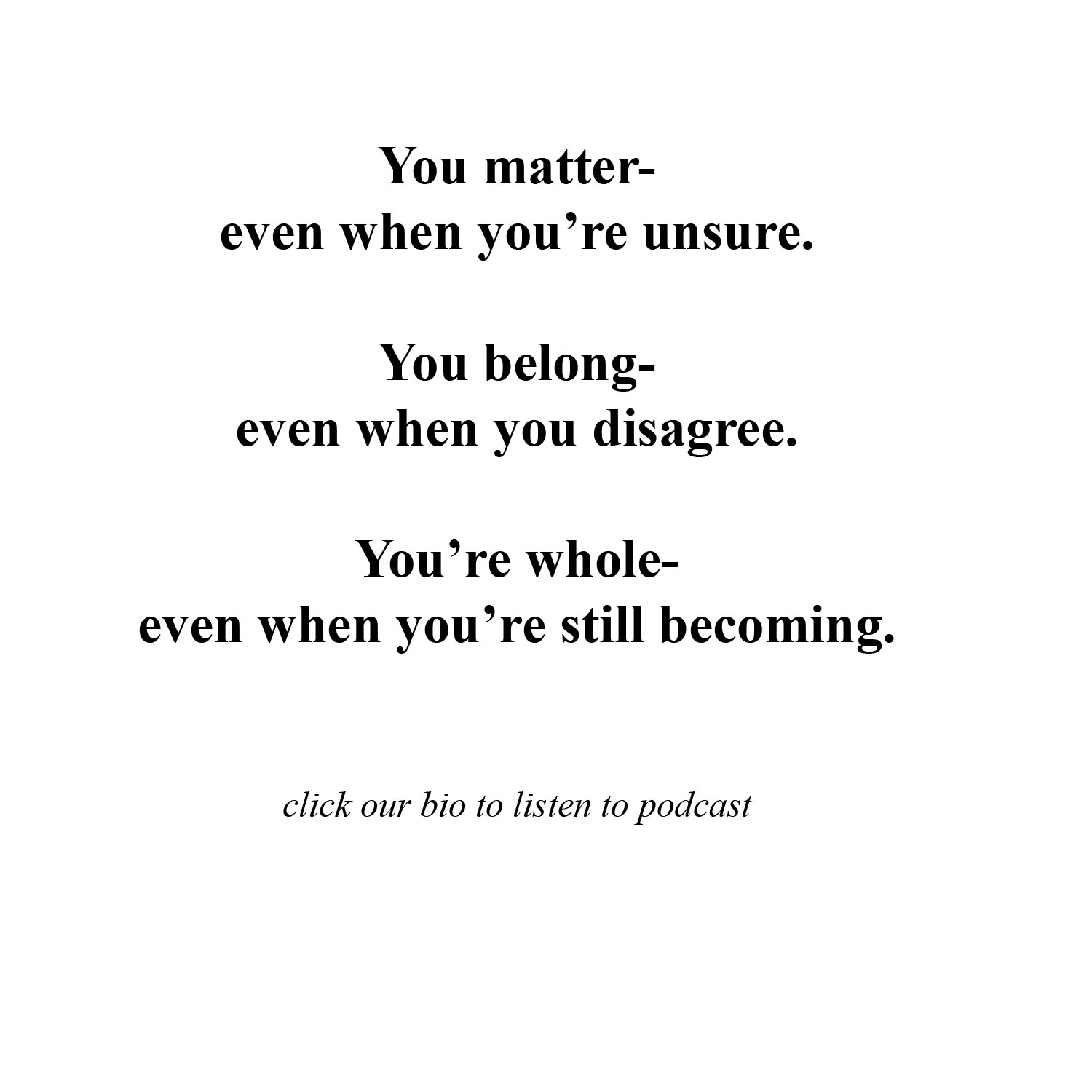
FAWN: okay, so bringing back to friendship, friendship can say you matter, even when you are unsure. You belong even when you disagree. You're whole, even when you're still becoming.
Mass movements, promise, transcendence, friendship, and by friendship, relationships, right? They offer presence and. Isn't that what we've [00:22:00] been talking about for all these decades with our friendship thing and our podcast is to be present. And that's why initially when we had our, dating website for platonic friendships, it was about being present.
Not on the computer, but in the neighborhood, in person,
right.
MATT: For me, I would say one of the key differences between mass movements and friendships, friendships lift me up. Mass movements push other people down to make me feel taller.
What do you mean I don't understand?
So and so, this, this glue root, this class, this person is bad, so we're cast them down. That makes me feel taller because they're lower than me. Ha ha. But a friendship lifts me up,
lifts me up, lifts them up, lifts us up, as opposed to putting [00:23:00] someone else down. That's all.
FAWN: And you get into that mode, that whole I I, I see it like a dark cloud, you know, like just a storm that just goes around, being a part of this mass movement of any kind. I think that for that to happen, people, it, it's because people are experiencing disappointment. They feel burdened, they're filled with shame.
And they don't have direction.
So the self becomes something to flee, not inhabit. And I think that's what's happening with kids. They're obviously for a good reason, not comfortable being human on this planet right now. Being comfort who is comfortable in their bodies.
I do. Okay.
You are also, you have a lot of, you're, you have a lot of experience though.
True.
But I'm saying when you're feeling discomfort, a mass movement can [00:24:00] come along and say, Hey, I'll comfort you. Oh, you lost your job. It's because of this group. Come join us. Do you know what I'm saying? You are not getting rid of the problem. You are not making your life successful.
You're not really looking at you and working on yourself and being good with you, but you're joining a movement and looking for some external force to fix things. Whether it's taking medication or overeating or over exercising or, you know, clubbing, I don't know, whatever it is that people do too much of to take their minds off of things and to take your mind off of your power take, taking your mind off of your inner.
Sacredness.
MATT: You're giving up control. Control of your thoughts, control of your body,
control of your emotions.
FAWN: There's a quote, faith in a holy cause is a substitute for the lost faith in ourselves. What's [00:25:00] happening here? If I cannot stand who I am, I attach myself to what I believe. The cause becomes a shelter from self confrontation.
And so this is escapism. This is how we can escape. By joining some group thought, some mass movement,
because the mass movement offers ready-made meaning, instant importance, moral clarity, all without requiring inner repair and but what's really happening is
they're thinking, what can I disappear into? So you don't wanna deal with yourself, you don't wanna take responsibility. Not you, you guys listening, but like people don't wanna take responsibility. So they, they disappear into this movement. It's kind of like crowd surfing, right? The person jumps in and then they get carried by the crowd,
MATT: right.
And God knows where they end up. Do they get thrown to the back of the crowd [00:26:00] and fall? Do they get on staging and then security comes and ejects him from the concert? Dot, dot, dot. No control.
Get poked in some terrible places along the way, who knows
wallet stolen.
FAWN: So basically giving up the self feels good to someone who experiences the self as a failure
because they feel eternally. Incomplete.
Incomplete doesn't mean unfinished. It's we're all unfinished. That's why we're alive. It means unable to tolerate oneself as is. That's what it means
when someone feels eternally incomplete.
So the movement offers rules instead of reflection, obedience instead of agency. Belonging instead of becoming
When people blindly without really understanding, follow the trend for them, it's what, what, what counts as not the individual [00:27:00] but the mass. Because individuality introduces uncertainty. Uncertainty, threatens cohesion. So individuality becomes dangerous.
And being an individual is scary because to be an individual, you have to choose without guarantees. You have to hold the doubt and hold it with grace. Like Matt lost his job a few months ago. We had, you know, it was scary and it was, it hasn't been the first time we've been in terrible situations, but like every time it just feels scarier.
So, to hold that doubt of not knowing what's gonna happen and gracefully knowing that you have power and it's going to be okay. You are gonna make it okay. To take responsibility
but if you're feeling inwardly unstable, this is terrifying. It feels like you can't breathe. It feels like [00:28:00] just, it just feels like death.
And then at the root of things, is that fear, the fear of standing alone.
But what if the deepest fear isn't isolation from others? It's being alone with one's own inner life.
There's a quote that says The frustrated individual is ready to sacrifice everything, so why quote unquote ready? Because the self feels like a bad investment. Being an individual
being on your own, being an individual demands, self-trust, patients inner authority, but going with a group, a mass movement. That mass movement bypasses all three. The self-trust, the patience, the inner authority,
big time.
So if you do feel pain, you feel alone. If you feel not confident.
Strive to tolerate that ambiguity. I can never pronounce that word. [00:29:00] Ambiguity.
Ambiguity.
Ambiguity.
That's how I pronounce the name. Oh my
gosh. We have to live with ambi. I can't say it.
We have to live inside of this shell of uncertainty, especially nowadays. For sure.
I wanna say the word again. You have to live in ambiguity.
I didn't say it right again, did I? Ambiguity. We have to be okay with imperfection
these people who have these things are powerful and they will not be victim to some mass movement that it's like being brainwashed. It's like being overtaken , like your brain gets taken, your, your, morals. Everything is out the window. You're just going with the, the crowd. And pretty soon you're not even looking at what's true, what's not.
You're just going with the crowd and because you're tired, you're not looking into things and going, wait a minute. What, or you're too scared to say something because the crowd is against you. Right, right. It's scary.
[00:30:00] A livable inner world protects against dangerous certainty.
So what happens when a person cannot be with themselves?
Friendship, real friendship does something radical. It makes individuality safe. It says, you don't have to vanish to belong. You don't have to be certain to be loved. You don't have to have surrender. You don't have to surrender your inner voice.
The opposite of that to me is a tragedy,
a tragedy.
That is creating a lot of what we're seeing out there.
MATT: For me, I would always, in conclusion, I would always want to question anybody who's offering any kind of absolute, anybody who's offering any kind of simple answers other than the most based definitions. You wanna tell me? One plus one is two, go for it. However, I know one plus one is one, depending on your sphere of a.
Academics, [00:31:00] mathematics. So be careful. Be careful and and surround. Try. Try as hard as you might. Try as hard as you can to A, be an individual. B, not try hard. And it's very, so hard. I'm having a difficult time with this not to be a victim and look. Try and be as comfortable as you can inside of, again, ambiguity.
I always talk about it as when you're in the soup, which is a kind of a, I used to be, I think a surfing term for when you're no longer on the cool part of the wave. It's all breaking weird, or it's all just icky. Being comfortable in the soup, being comfortable when even your footing isn't necessarily in balance.
FAWN: Remember that story I told you a long time ago with my, so we were cross training in martial arts, Matt. Yeah.
You were.
Well, I was. And um, my [00:32:00] sensei, petite sensei, he had us do this one move where you were, you had your one leg up straight out, completely parallel to the ground. So hip level. Try to hold your legs straight like that, even for one second.
But we had to hold it for like 20 minutes.
Have fun.
And he said, Hey, enjoy it.
Enjoy.
No, but he's, you know, you have to be comfortable in that uncomfortableness
and there you go. And point of fact,
you know, sit back and pretend you're sitting, you know you're on the couch, right.
Well, secret cycling trick is when your muscles are really aching, like you're climbing up a monster hill and like you can't hardly do anymore.
Just smile. It makes it easier. Swear.
Another thing I heard is like when you're running to bring your thumbs [00:33:00] up when you're running. I don't know.
Okay, then.
Alright, well. There's a lot to unpack, and I said, oh my goodness. Probably did I sound like a robot as I was talking, because I'm like, there's so much I wanna say.
Right.
But I was telling Matt, I don't wanna get into the specifics of why I am saying what I'm saying, because I, I don't want it to deter, just in case you disagree with what I'm saying. I don't want you to pin me to whatever belief system out is out there, because that's exactly what I'm trying to avoid, is that mass consciousness, that mass movement of whatever it is.
I, I, um, mm. I'm trying to remind us to go with our own strength. We don't need anyone. No one's going to save you. You, your inner, your, your divine essence is what will save you. It's what [00:34:00] will be there. It is the constant. , That's what attracts other friends that are loyal, that are true friends.
And that's how we create a healthy society because that grows and everyone in the community, most of them will be strong like that. And when times where you're not strong, you're still strong, but you're not as strong, someone will say, Hey. Hey, and you snap out of it and you go back to your strength, to your inner core.
And you know, that's how we can support each other. And that's how we can look at opposing views or look at something when someone disagrees with us and not so vehemently say, you are wrong. You are an idiot. You are, you're a whatever it is.
Okay. That's it. I mean, I, I don't know.
It's been a long one.
Uh, I just wanted it to have a 20 minute [00:35:00] conversation, but here we are. Okay. Thank you. we'll talk to you in a few days. Have a beautiful, every day
be well. Hold your truth.