Episode Transcript
FAWN: [00:00:00] Welcome back to Our Friendly World, everybody.
MATT: Hello.
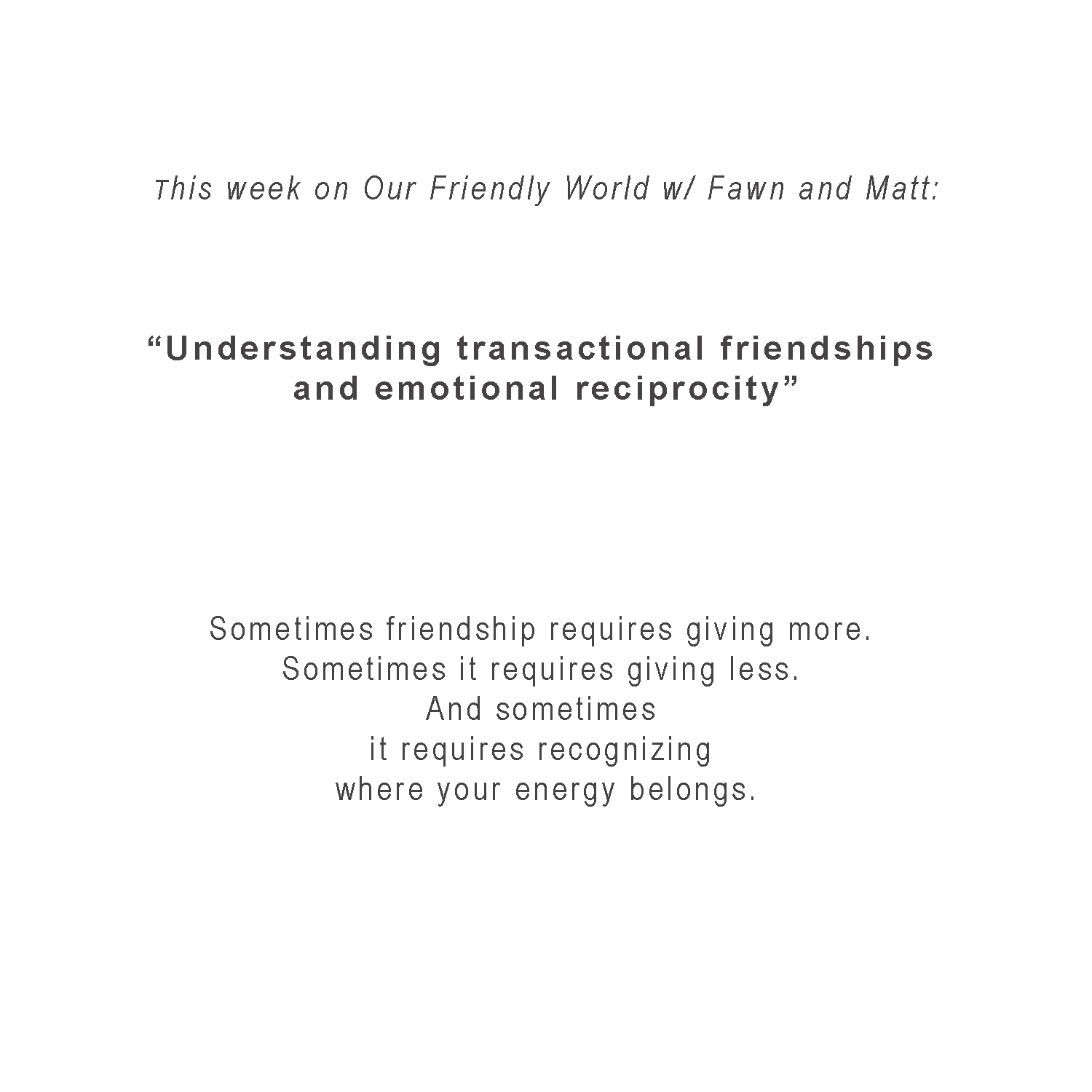
FAWN: Okay, so we're gonna talk about the different kinds of friendships again. However, with focus on... Help me figure this out. A focus on when you realize you have a transactional friendship, like you realize that. I, I realize I have this friend that I've had for a very long time, and I can see how transactional it is, but sometimes it's not but it's rare.
It's rare for that to happen within this friendship, and I want it so much to be a non-transactional friendship. I want it to be a family friendship, like, uh, we just love each other. But it's not the case, and it's so hard to deal with. It's so hard because it's sad. It makes me feel sad. And [00:01:00] because Because of that, there's a confusion that sets in because then I start thinking, "Well, why does this friend do this?
Why, why is it that, um, their opinion is it? That they have absolutely no room to hear my advice or my opinion, or they're constantly picking on me," I feel like. Not constantly, not picking on me, but like I just feel that I don't have the field where I can just, without having my words scr-scrutinized, just have, uh, an opportunity to express what I'm going through.
Because sometimes I don't have it worked out. I haven't figured out what it is I'm going through. I need a friend to bounce things off of to, to understand what is happening, and not [00:02:00] until I verbalize it do I realize that. But I just feel like with this one friend, it, um, my words are used against me. Like, um, for example, I, I guess I said, "I'm trying to find work"- Mm-hmm
one too many times for her, for her liking. And she's like, "You know, s- you, you said something that struck me." And I, and I s- I was so like excited 'cause I thought, "Okay, what credit is she gonna give me?" Like, I, 'cause I, I, you know, I try to come with- Mm-hmm ... positivity. I, I offer things. I don't take all the time,
i, if I do take, I make sure that I give way more than I take.
MATT: Mm-hmm.
FAWN: I seriously thought, "Okay, she's going to, give me a compliment," and it was the opposite. And she was saying, "I've heard you say try-" And she just proceeded to give me a lecture for 20 minutes. [00:03:00] And the thing is that I had already come to the conclusion on my own-
MATT: Right
FAWN: that I had been using the word try, and I had switched that. So now I have to sit there and listen to her for 20 minutes lecture me, because if I do butt in, and I did try- Mm-hmm ... to say, "You know what? I stopped that actually," that it, it just seems like I'm just, uh, denying it. You know what I'm saying? Like blindly denying.
"You're wrong. I'm, I'm just..." "What I'm saying is you're wrong." "I'm not saying that anymore." You know? Do you know what I'm saying? I do. It, it, it seemed like I was just, uh, protesting. Protesting?
MATT: Yes.
FAWN: Um, but it, it bugs me a little bit because it happens quite often, and I never do that to anyone. I never do that to a friend.
Well, maybe I shouldn't say never, but, uh, it just feels like it happens a lot with this person.
MATT: Mm-hmm.
FAWN: And this person, at the same [00:04:00] time, has been there for me and has helped me through some really hard times. So it's hard because when I come down to being realistic, I realize it's a transactional friendship, that- I, that's what it is.
I just feel like she doesn't totally respect me completely. Like, you know how you treat a young, younger sibling-
MATT: Yes ...
FAWN: where you feel like they don't really know what they're talking about, so I'm gonna let them know? I feel like it's that kind of thing, and that just blows me away. Do you know what I'm saying?
MATT: Totally.
FAWN: Because there are so many subjects and so many areas of, experience and topics where I actually have a lot of experience, and when she comes to that experience, she tries to tell me about it like she invented it, where all along I've been telling her about this said experience. Mm-hmm. I don't know if this makes [00:05:00] any sense 'cause I don't wanna get into details.
I don't wanna- Well, but we're- ... hurt anyone's feelings ...
MATT: we're, we're jumping between a lot of different hoops where, you know, your, you, what you last talked about was kind of the alpha versus the beta friend, and she views herself as an alpha. We can talk about the fact that, uh, uh, you wanna do... And it's, I swear to goodness, it's, it's a bonafide term.
It's on Wikipedia. You can look it up. But sometimes you just wanna rubber duck something, which is you just wanna have somebody listen, and you wanna kind of work your way through it yourself. And, and it's, it's a common scenario we do in computer programming. We'll rubber duck something because in the process of explaining it, sometimes you come to the right conclusions.
FAWN: It's not that I wanna come to it myself or fix it myself, Matt. It's that I don't know how to verbalize, I don't know how to put into words something complicated that's happening. Do you know what I'm saying? I do.
MATT: And-
FAWN: So as I'm talking- Right ... I may use the wrong [00:06:00] word, like try, and it just gets used against me.
Mm-hmm. Like, why, why must you harp on that kind of stuff? I don't understand.
MATT: Well, there's also what's called the rush to judgment that happens.
FAWN: Yes, that's what it is, a rush to judgment, and it happens to me all the time with people. Why? I mean, they r- they rush to judge me, and I never judge people. Okay, I'm sorry.
Go ahead.
MATT: Right Because people... Okay, so then we get into the masculine versus the feminine. Oftentimes the feminine energy just wants to express an issue, but the male energy wants to rush to solve it. You know, as, as a man-
FAWN: Honestly, that's
MATT: fine ... I wanna
FAWN: fix your
MATT: problems.
FAWN: Well, thank you. No, I wanna fix the problems.
MATT: The, the trick is rushing to it.
FAWN: Mm.
MATT: You can't rush to it. You have to make sure things get [00:07:00] expressed, and we see this... Welcome to my profession. We're just talking about computer programming today, by the way, folks. This is what we do. A client always believes they have a solution. Clients are very smart.
Oftentimes the client has, the right solution, but more often than not, they don't. You need to hear them express their frustration, express their problems, let it sit for a minute, and then figure out what the right answer is.
FAWN: Well, there are two things happening. You're so emotional that all- you can't hear anything.
You need to clear away the emotion, right? Because it's so strong that it's muffling your hearing.
MATT: Mm-hmm.
FAWN: You know what I'm saying?
MATT: Right.
FAWN: It's like when we get into a fight and you apologize immediately, I, like, I don't know, a month later- ... two years later, I'm like, "And you never apologized." And you said, "Yes, I did."
MATT: I did, twice.
FAWN: But, but you apologize immediately when I'm still, in the [00:08:00] fits of rage, and I don't hear it. So when we're emotional, when I'm emotional, I don't hear. So I need the emotion to settle down so I can hear the solution, right? Okay.
MATT: Right. And there you
FAWN: go. Is it just me? Well, you're that way, too, when I try to help you and you're emotional.
MATT: Sometimes, yeah. Again, feminine versus masculine, and I, I hate the fact that we've genderized it, but it's, it was traditionally how I guess things were. But, um-
FAWN: Look, now I just think we all need solutions.
MATT: Right.
FAWN: But we also need to- To express ... calm down.
MATT: A- and that's the thing, and sometimes I just want somebody to listen, and sometimes I want somebody to, you know, grab the big wooden stick and beat me over the head with it.
FAWN: No, you don't.
MATT: That was- That's a terrible description ... that's
FAWN: an old Zen description. Let's get rid of that description. Ah. It's too violent. My goodness. No.
MATT: I just wanna gain, gain clarity, and I want somebody to explain what's, [00:09:00] what's happening sometimes. Right.
FAWN: Right.
MATT: You know? And, and it's, it... You run the gamut, and, you know, it's, it's, it's definitely in my relationships identifying which headspace a person is in, especially my personal relationship, Sweet Pea, is, is key to that, and really, you know, uh, giving the opportunity for things to breathe.
FAWN: Mm-hmm.
I mean, okay, so I'm all over the place. One of the things I don't understand is, or I didn't, we already had this conversation and you helped me so much. I just don't understand why My point of view or my experience or my expertise is dismissed by this person It's wild to me. And what was your, what was your response to that?
MATT: Uh, well, it's, it's actually morphed now. But if you think about her reality, right, for a [00:10:00] moment,
She has her own business she runs as a sole proprietor. She basically runs her family So she's expected to have the answers. You know, from literally, you know, "Where are my shoes, Mom?" to, "How much am I gonna charge this client for this given whatever?"
FAWN: Well, would you say I am in the same position? But you and I share responsibility.
We
MATT: share responsibilities. Right. It's v- it's, it's a different thing.
FAWN: Right.
MATT: You know? And, um, locked into that single role all the time, it sometimes lends- But she was like
FAWN: that before. Sh-
MATT: And welcome to the extension of her life going forward. When she did
FAWN: have a partner- She- ... she was the same way.
MATT: She's very inflexible, and she was that way- Yeah,
FAWN: inflexible
MATT: when I first met her.
FAWN: Yeah, inflexible. Yeah.
MATT: Right?
FAWN: Yeah. I
MATT: mean, boom.
FAWN: What do you, what, why do you think people are inflexible?
MATT: Well- [00:11:00]
FAWN: And if they are, then why are they friends with me? Because I'm so flexible that they're allow- they, they have, uh, an opportunity to flex on me. 'Cause, um, let me tell you, I can only handle so much.
MATT: Well, you see, you ask two different things all at once, and, and it, it can sometimes get hard to distinguish between them, especially inside of a podcast, and I don't wanna leave our, our listeners hanging. So, you know, the first question is, uh, why is this person the way they are? Why is anybody the way they are?
Because in the past when they've been this way, they've been successful In whatever definition success has. That's why people generally repeat patterns, they do things the same way again. There's a certain predictability. They know what the result is gonna be, and theoretically they're satisfied with that [00:12:00] result.
FAWN: Mm-hmm.
MATT: Okay? Now, why are they friends with you? Why is anybody friends with anybody? I mean, a lot of it, I think for me, comes down to... This is gonna sound very, very challenging and interesting. I don't do the Facebook, I don't do the Instagram, I don't do the-
FAWN: No social media
MATT: except for our podcast
Pictionary, whatever it's called.
FAWN: Mm.
MATT: Um, not Pictionary. What's the one with all the pictures?
FAWN: Instagram. I don't know.
MATT: No, the one you scroll forever and you see pictures. Pinterest. Pinterest, there you go. Thank you, because I was never gonna come up with that. Friends challenge me, which I appreciate a lot.
They also give me new input. They, they give me new perspectives. They give me, uh, different ways of, of seeing things.
FAWN: Mm.
MATT: You are really good at giving people [00:13:00] interesting, different, challenging ways to see things, even if they initially dismiss you. Because what you're seeing, honestly, you, you give somebody something, they sit with it sometimes for years, and then they throw it back to you like they invented it.
FAWN: I hate that. She does that to me all the time. All the time.
MATT: And it-
FAWN: It makes me crazy.
MATT: It's because it was such a challenge... It was perhaps such a challenging thought, but so true that it took that long for them to really internalize it-
FAWN: Yeah ...
MATT: and grow because of it. And then, of course, completely dismiss the fact that they got it from you.
FAWN: Yeah, always. Always. And that's when we started talking about, well, you have to just come to terms with the fact that this is a transactional friendship And, and then we were talking about, okay, from now on... [00:14:00] Because what you were saying what she gets from me is like... So I learned something from another friend of mine, an, uh, you know, a very long time friend of mine.
Years and years ago, we, we did this thing where we hold things for each other.
MATT: Mm-hmm.
FAWN: And so I've been passing that along. So my friend passed it along to me, and then I've passed it along to everybody else. And this friend who or- initially passed it on to me, as well as other friends, they'll say what they want, and I will hold it for them.
And I swear it, it, it happens for them. It comes to be for them. Like, it happens. It manifests. Whatever word you wanna call it, it appears. And they'll say, "What's, what's your thing? I'll hold yours." And never, never. And so you were saying, I... They don't have the ability to, and that's why they're friends with me because I do get that, that it...
I can, I don't know, magically, [00:15:00] like, I'm part of the creation process. You know what I'm saying?
MATT: Right.
FAWN: I sound so egotistical right now.
MATT: Heyo.
FAWN: Um, but it only works one way. So, and they, they win, but it's time for me to win, but the only way for me to do that is just to do it by myself. Like, it's a transactional friendship.
It's not, it's not gonna happen with them. It's not gonna happen there. So whatever it is that I'm holding, I need to hold for myself, unfortunately.
MATT: And o-
FAWN: And it, it just feels lonely.
MATT: Oftentimes that is the case.
FAWN: Because a- again, it's another example of a one-sided friendship in some ways.
Right. Because I can make things happen for them, but I know I have to come to terms with the fact that it's not going to be reciprocated. And it's not that there's no friendship there, it's just the dynamics of [00:16:00] it. my superpowers are ignored, dismissed.
MATT: Right.
FAWN: Yet I'm helping them a lot, but it's not even seen.
Yet they're still friends with me because obviously they are getting something.
MATT: Right.
FAWN: Right? But here I am all frustrated and sad.
MATT: Right.
FAWN: But once in a while, once in a while, they are the cavalry that save my life. So it's confusing, Matt.
MATT: It is.
FAWN: So- So I forgot what your advice was, like the, with the whole thing, like in a pretty little bow.
MATT: What was your advice to me last week?
FAWN: Oh my. Mind your own business. Because you, you at work will go out of your way and spend hours helping people, and not only just helping them technically, but what you do is [00:17:00] you emotionally figure out what, like what, what emotional, w- how to f- help them emotionally.
And sometimes if they can't figure it out, if a boss needs to step in, you will tell the boss, "Hey, this person needs this." But that gets you in trouble because then it's like a tattletale situation. They don't understand that you're genuinely helping. Then it becomes accusatory or you're telling on someone, like instead of them understanding, look, this person emotionally needs this.
And I think in business they don't deal with emotions, most people.
MATT: Right.
FAWN: You know what I'm saying? Yeah. So what they hear you say is not what you're saying, and it, it just gets you in trouble, and you've spent all these hours aside from work, work hours, and then it gets you in trouble. So finally, after all these years, I'm like, "Matt, make sure you mind your own business.
Let them figure it out on their own. Don't. It's [00:18:00] none of your business." I'm sorry. Did I give too much information?
MATT: No, no, no. You're absolutely right. It, it's one thing if I'm in a more formal to formal mentoring role, but I, I sometimes can't help myself-
FAWN: You mentor
MATT: everybody- ...
FAWN: adopting the mentoring role
'cause
MATT: you wanna help
FAWN: everybody.
MATT: Because exactly, and it doesn't matter if you have 10 more years of experience than I do. If you've got a blind spot, I'm gonna help. I'm gonna see what I can do to help you with it.
FAWN: I just, I just feel like at this moment in time that everything is so screwy. I don't know.
Maybe I'm wrong. Because I believe that our purpose for being alive is to make life better on the planet-
MATT: Mm-hmm ...
FAWN: in the world. We are here to make life better. And here I am telling you, "Hey, mind your own business," because it's not gonna work here. So is it okay to come to terms, much like understanding, hey, this is transactional, this [00:19:00] friendship?
Coming to terms with at work, Just mind your own business for now. Zip it.
MATT: And there you go.
FAWN: Is that okay, though? Do you know what I'm saying?
MATT: No, no, no. It, it absolutely is. You know, I'm hired to fulfill a role, to perform these tasks, and to move on. I will continue to share information that people have given me.
I will continue to share technical information like, "Hey, you need to do this. You need to... This is where the database lives," et cetera, et cetera. But, you know, that, that more mentoring, like, "This is what you should be doing. This is what I would do in your position," eh.
FAWN: I guess this is the time where you, uh, you should be asked.
If you're not asked, much like an angel, right? They say that angels can't step in and help you until you ask for help, right? They're waiting for you to ask for help. So if, if they haven't asked you, mind your own business.
MATT: Right.
FAWN: I'm [00:20:00] sorry. So this was a solution to my problem? Now I forgot what
MATT: Mind your business.
FAWN: Oh, mind my own business. How so?
MATT: Be very judicious with the things that you share and have an understanding that you're willing to go 200%, but they're only willing to go 20.
FAWN: Yeah. Okay. It is really lonely though.
MATT: Well, you do have Type 3 friends, so you know- I do? ... those, those are the relationships that you need to, you know, maybe-
FAWN: Type 3 meaning they love you no matter what.
Just you. They love you just because you're you.
MATT: Exactly.
FAWN: Yeah. Well, I can't think of those right now.
MATT: Well, sometimes that can be hard when you're- ... when you're looking at just because you've had-- And, and this is an important lesson right here, is just because you've had a friend for five years, for seven years, for nine years, sometimes it just means [00:21:00] that
Oh God, what's the way to put this? This is challenging. They're not a... Just because you've had a friend for a long time doesn't mean that they're a somebody who loves you because of you, doesn't mean sometimes, and this is where it gets really uncomfortable, that they're even really your friend, but we're not talking about that in this case.
FAWN: Or that they see you.
MATT: Or that they really understand all that you are. This is someone who has just borne witness to the experiences of your life that when they've known you.
FAWN: Right.
MATT: Sometimes that's the case.
FAWN: Yeah. And sometimes you need that, but again, you have to look at it like, okay, is it one, two, or three?
MATT: Right. Exactly.
FAWN: Even though they're childhood friends, right?
MATT: Right.
FAWN: Okay. I think this is such a big issue.
MATT: And there's a lot of emotions here.
FAWN: Yeah. I think I'm gonna... For me, I'm going to S- just, uh, take a pause here. [00:22:00] Is there anything else you wanted to add?
MATT: Nope.
FAWN: Okay. All right. Well, thank you for listening.
Have a lovely every day.
MATT: Be well, everyone.
FAWN: See you soon.